
The Fed Can Create Volatility. Can It Tolerate the Consequences?
For Kevin Warsh, it is a case of being careful what you wish for

Kevin Warsh wants to elevate the role of the bond market in the determination of monetary policy.
The Federal Reserve has spent two decades training investors to expect that rate decisions will be telegraphed weeks in advance and that any change in direction will arrive only after a procession of carefully staged speeches. Markets no longer walk into an FOMC meeting asking what the central bank will do. They arrive knowing the answer and spend the afternoon parsing whether the statement’s language deviates slightly from the script. Warsh believes this predictability has corroded price discovery. Knowing the outcome of every meeting in advance is not a sign of a healthy market. It is proof that central-bank choreography has displaced the repricing function that Treasury markets are supposed to perform.
The Illusion of Control
Forward guidance began as an emergency response to the zero bound. With official rates pinned near zero, the Fed promised that rates would stay low for an extended period, hoping to drag down longer-term borrowing costs and encourage households and businesses to spend. The emergency tool hardened into a permanent operating principle, and the central bank moved from setting the overnight rate to attempting to manage the entire expected path of interest rates. The Fed, like all forecasters, does not know where inflation, unemployment, or growth will be twelve months from now, and it has demonstrated this repeatedly. Modeling the future trajectory of the economy has historically been a thankless task, especially as the economy evolves under the weight of decades of relentless innovation. Many of the models used by Fed economists were developed in the 1950s and 1960s when the US economy was less global, analog, and manufacturing-led, a much more cyclical environment than the service-driven framework we find ourselves in today. Forecasting is difficult enough in stable economic conditions.
Federal Reserve forward guidance converts those uncertain projections into something markets treat as a commitment, and Treasury yields, mortgage rates, corporate borrowing costs, and equity valuations are then constructed around a policy path that was never as reliable as investors were encouraged to believe. When the forecast changes, the Fed changes with it, and the market discovers that yesterday’s guidance was a conditional opinion dressed up as institutional certainty.
The Fed Controls Less Than It Admits
The deeper problem is that the Fed’s influence over inflation and employment is weaker than the institution concedes. Interest rates can affect credit creation, housing turnover, asset prices, and the appetite of leveraged companies to borrow. They cannot build power stations, produce natural gas, repair broken supply chains, remove tariffs, or expand the pool of skilled workers. Monetary policy cannot reverse the impact of automation on white-collar employment, and it cannot force hyperscalers to slow an infrastructure program they regard as essential to their survival. The forces increasingly driving inflation and employment are supply-side: energy scarcity, fiscal transfers, trade restrictions, immigration, and technology sit beyond the reach of the federal funds rate. The Fed can weaken demand elsewhere in the economy in response to a supply shock, but that is a blunt instrument that punishes the rate-sensitive sectors while leaving the source of inflation untouched.
This is the argument I made in Growth Without You. Economic growth is becoming less dependent on labor, credit expansion, and monetary stimulus, with productivity replacing employment as the marginal driver of output. AI can lift GDP, margins, and corporate profitability while simultaneously reducing demand for human cognition, which means unemployment can rise without a recession while inflation falls because the cost of producing goods and services declines. The Fed’s traditional playbook has no obvious answer to that combination, and guidance from an institution losing its grip on the variables it forecasts is worth even less.
Volatility Is Inevitable
Remove the guidance and volatility rises, which is unavoidable and, up to a point, desirable. The two-year Treasury yield will become more responsive to inflation, employment, and activity data. The distribution of possible outcomes around each FOMC meeting will widen, options markets will demand more compensation for uncertainty, and longer-dated bonds may carry a higher term premium because investors will no longer assume the Fed intends to hold their hand through every turn in the cycle. None of this means yields must rise continuously, and weak data could produce larger rallies because the market is no longer anchored to a pre-announced path. The defensible conclusion is that moves in both directions become larger. Uncertainty was always present; forward guidance merely suppressed its market expression, and Warsh appears comfortable watching it return.
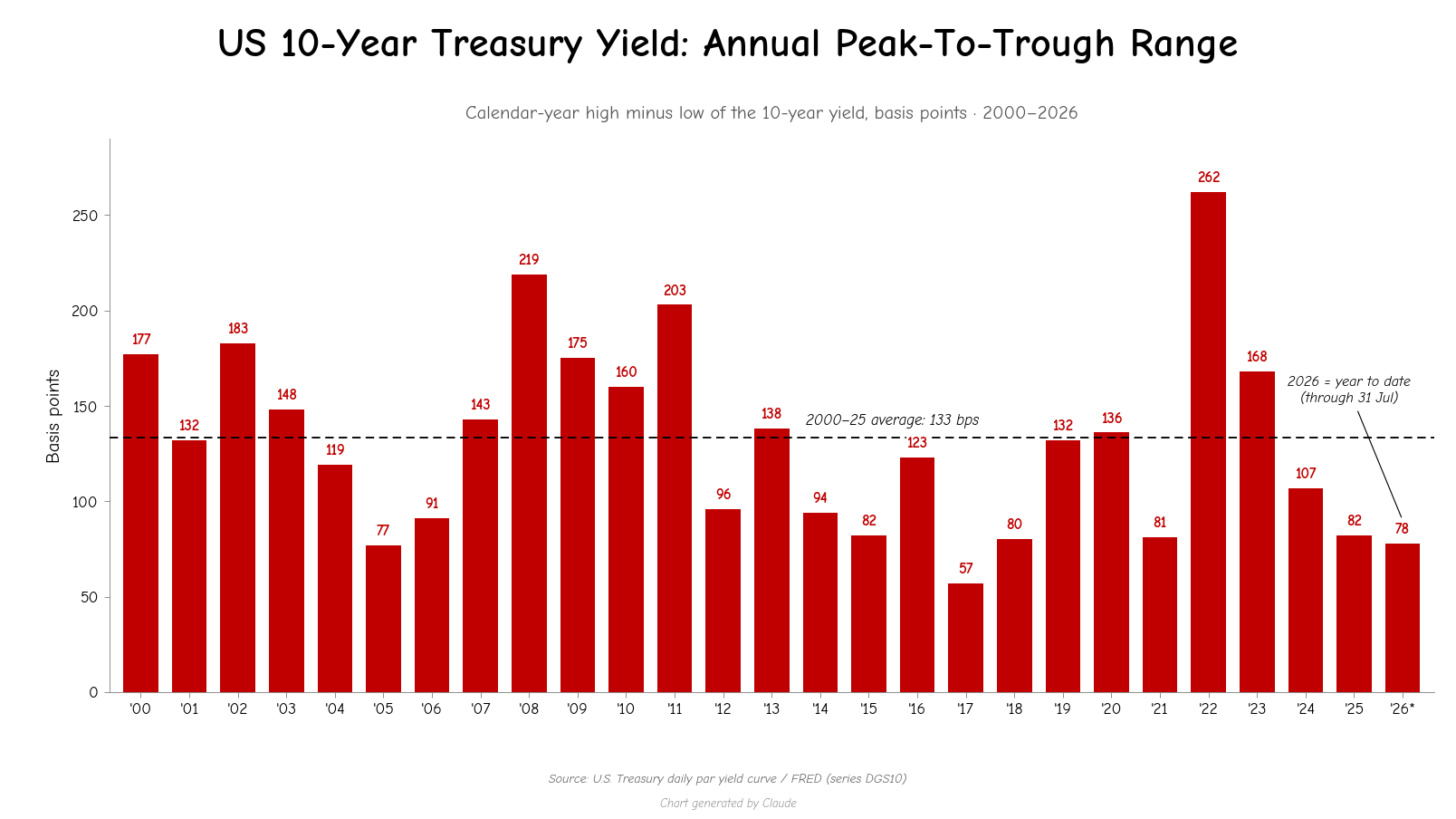
The reality is the bond markets have not been volatile since QE became the prevailing policy tool in the previous decade. The average range for the US 10-year bond, peak to trough, since 2000 has been 133bps. Since 2012, only four years have produced a range in excess of the mean, with eight years experiencing ranges of less than 100bps. Lower absolute yields are a meaningful cause of the lower yield ranges, and bond price volatility would tell a slightly different story, but the message is clear. Long-duration Treasury yield swings have been muted when compared to prior cycles, and this is reflected in lower annual ranges, realized volatility, and poor Sharpe ratios for bond trading. While there is never just one answer, forward guidance definitely played a role.
Higher Yields Carry Less Information Than Warsh Believes
His confidence in the signal contained in higher long-term yields is harder to defend. The textbook assumption is that rising yields tighten financial conditions, weaken housing, restrain consumption, and eventually lower inflation. Some truth survives in that sequence, but the transmission mechanism has decayed. Fixed-rate mortgages are the clearest example. Higher Treasury yields hit new buyers, refinancers, and households that need to move, while leaving untouched the monthly payments of homeowners who locked in cheap thirty-year loans. Rather than producing an orderly housing slowdown, higher rates have frozen turnover, with existing owners refusing to surrender low-cost mortgages while prospective buyers face elevated financing costs and thin supply. The result is reduced activity without the price reset policymakers expect.
The corporate sector tells a similar story. The largest incremental issuers in the investment-grade market are increasingly the hyperscalers and the companies at the center of the AI buildout, and while these firms are not indifferent to the cost of capital, they are far less sensitive to it than the conventional model assumes. Microsoft, Alphabet, Amazon, and Meta hold enormous cash balances and strategic reasons to secure compute, data centers, electricity, and network capacity before demand is fully visible. A higher coupon will not persuade them to abandon projects they believe will determine competitive leadership for the next two decades. Borrowing capacity across these firms remains deep, and the willingness to invest is governed by strategic necessity rather than by modest moves in long-term yields.
The Press Conference Problem
The press conference post each FOMC meeting has become the contradiction sitting at the center of this policy transition. Warsh cannot appear before the press and refuse to discuss the future, because every serious question is forward-looking. Reporters will ask whether inflation is improving, whether employment is weakening, and what would cause the Fed to move at the next meeting. Even an answer framed around risks and incoming data moves markets, because investors immediately translate it into probabilities for future policy. The distinction between explanation and guidance is therefore less clean than it first appears: a chair cannot explain the current decision without revealing something about how the institution views the months ahead, and the tone of the answer, the risks emphasized, and the conditions attached to future action all become guidance whether he intends them to or not.
Chairman Warsh therefore has three realistic choices. He can keep holding press conferences and accept that markets will mine every answer for a policy signal, restrict them to meetings where rates change, or new projections are released, or eliminate them entirely and rely on written statements, speeches, and congressional testimony. After his last performance, fewer appearances look more likely, and that is the plausible reform. Limiting press conferences to meetings with updated projections or an actual policy change would reduce the volume of central-bank commentary without pretending that the Fed can discuss the economy publicly and avoid influencing expectations. The problem cannot be resolved through better wording. As long as the Federal Reserve speaks, markets will treat its words as guidance, and Warsh can reduce the frequency and precision of those signals but cannot eliminate them.
Be Careful What You Wish For
This leads to the question that should define his chairmanship: can the Federal Reserve tolerate the consequences of the volatility it creates? Silicon Valley Bank supplied an answer. In March 2023, higher yields exposed losses on long-duration assets and helped trigger a confidence crisis across regional banks, and once contagion became a risk, the Fed dropped $300bn of liquidity to stem the threat. The intervention was sensible, but it exposed the contradiction. The Fed tightened policy, generated losses across the banking system, and then supplied liquidity when those losses threatened financial stability. The institution that insisted markets absorb interest-rate risk stepped in the moment that risk threatened to spread, and Warsh inherits that reflex whether he wants it or not. He may prefer a cleaner market, but the White House, Treasury, Congress, and the rest of the FOMC will be less enthusiastic when cleaner pricing produces bankruptcies, falling asset values, or stress in strategically important sectors. Political tolerance for financial volatility is consistently overstated. Higher mortgage rates are acceptable until housing activity collapses, wider credit spreads are tolerable until companies cancel projects, bank losses are manageable until depositors question the safety of regional institutions, and equity declines are welcomed as healthy discipline until they threaten consumption, confidence, or an election.
Warsh’s timing to implement this strategy is awful. It has been five-plus years since US CPI has been at the 2% target. 30 Year Long Bond yields are at their highest level since 2007, and the combination of record deficits and hyperscaler issuance means that the supply of “high-quality” debt securities is vast. If the market, freshly appointed as judge, jury, and executioner, comes to the setting of rate policy and decides that the prevailing scenario is no longer sustainable, the United States could face its first-ever sustained period of rising risk premia. Rising yields and a steepening curve, driven by the idea that the issuance schedule cannot be absorbed, would be devastating for risk assets and risk-free assets alike, and a US equivalent of the UK’s “Liz Truss” moment cannot be ruled out. It is extremely unlikely, but when central banks leave it to the markets to determine where interest rates land, you introduce a level of risk that forward guidance did stem. The notion that free markets, if left to their own devices, can efficiently determine the price of money is nice in theory, but markets are not perfect, and oversight will be required to make sure that predatory behavior by well-capitalized market participants doesn’t manipulate interest markets for gain. There is an apparent hypocrisy between the actions of Kevin Warsh and coordinated Japanese Yen intervention. Allow markets to run their course to a point should be the mantra of US economic stewards. Kevin Warsh may be no different.
Honesty Is Not Effectiveness
Whether any of this makes policy more effective is a different question, and there is little reason to believe it will. The Fed’s difficulty does not stem primarily from poor communication. It is a weakening relationship between interest rates and the economy they are supposed to steer. Fixed-rate mortgages shield existing homeowners, cash-rich hyperscalers invest straight through modest changes in borrowing costs, supply-driven inflation sits beyond the reach of the funds rate, and AI-driven employment losses will not be reversed by cheaper money. Greater uncertainty may produce a more honest Treasury market, but honesty and effectiveness are not the same thing. Doubt about the path of rates can be shifted or concealed, never eliminated, and stripping it out of Fed communication will simply expose risks that were always present, with some borrowers struggling while the companies driving the AI investment cycle keep spending because they can afford to. The reform will be judged not by the first rise in yields but by what happens when higher volatility produces a casualty. At that point, Warsh will face the same choice as every modern Fed chair: allow markets to impose discipline and accept the economic consequences, or intervene and protect the system from the very risk he wanted investors to price. The Fed can create volatility whenever it chooses. We are about to discover whether it can tolerate the consequences.