
How the US Tax Code Subsidizes Artificial Cognition
Why AI Makes Human Workers More Expensive Before Productivity Even Matters

One of the most frustrating things about publishing a book is realizing, two weeks later, that you should have included one more idea. In Growth Without You, I spend a lot of time on the fiscal sustainability problem that artificial intelligence creates for the United States. The argument was not that Washington spends too much money, although it does, or that entitlement reform will be easy, because it will not be. The deeper problem is that the U.S. tax system was built around labor income at precisely the moment when AI is beginning to reduce the economy’s dependence on labor. That was the point I made in the book, and I still believe it is correct. What I should have added is that the tax code does not merely fail to adapt to artificial intelligence; it actively pushes companies toward replacing human cognition with software.
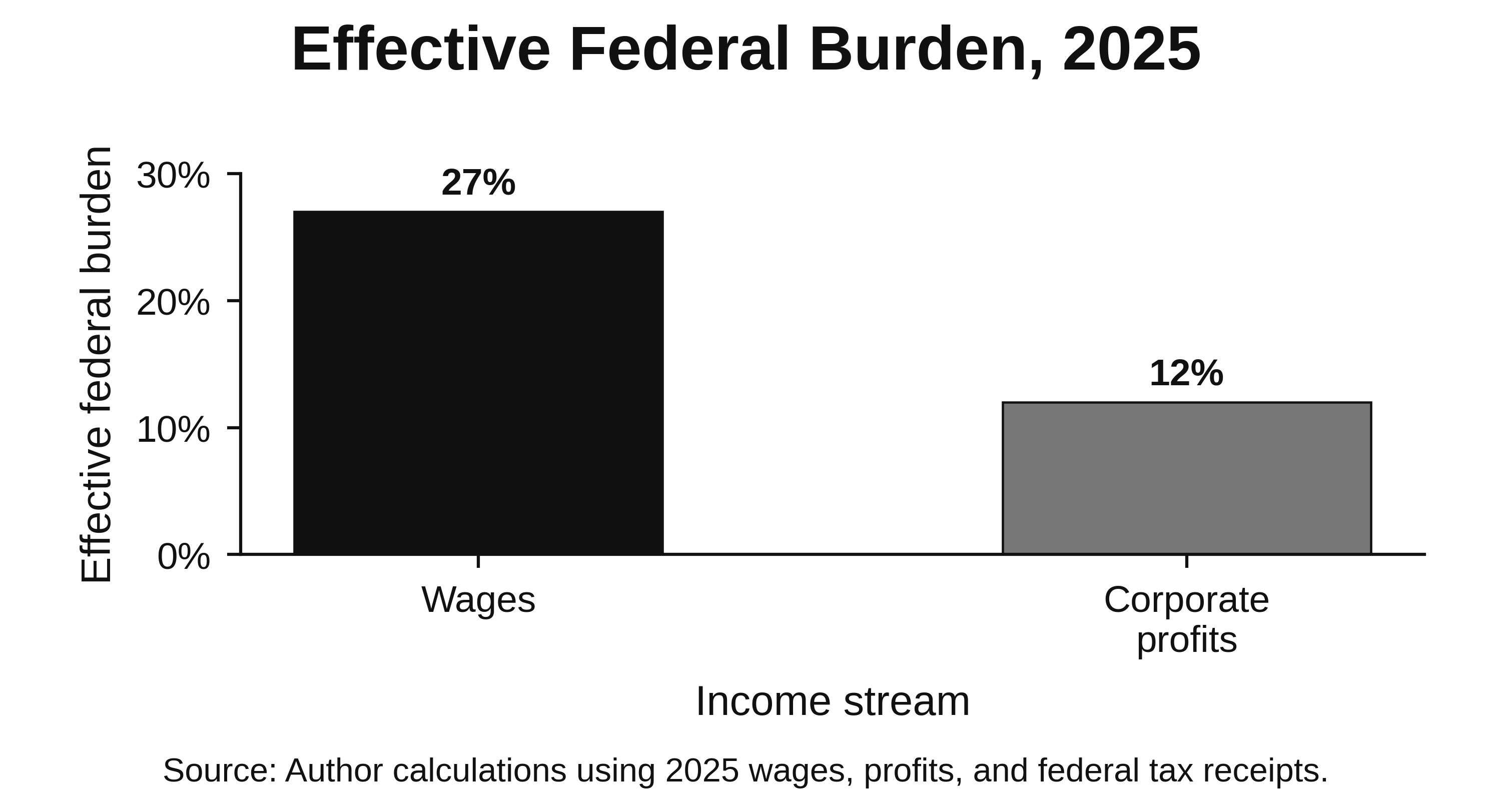
The United States has a tax base problem hiding in plain sight. In 2025, the U.S. economy generated roughly $13 trillion in wages and salaries, compared with about $4.1 trillion in corporate profits. Labor remains the larger pool of income, but the direction of travel is what should worry policymakers. Profits are growing faster than wages, corporate margins are expanding, and AI gives companies a way to increase output without adding workers at the same rate. The government taxes the slow-growing pool of income heavily and automatically. It taxes the faster-growing pool more lightly, with more room for timing, deductions, deferral, and avoidance.
The arithmetic already looks uncomfortable. The IRS collected roughly $1.95 trillion through individual income-tax withholding and another $1.58 trillion through FICA in fiscal 2025. FICA stands for the Federal Insurance Contributions Act, the payroll-tax system that funds Social Security and Medicare.
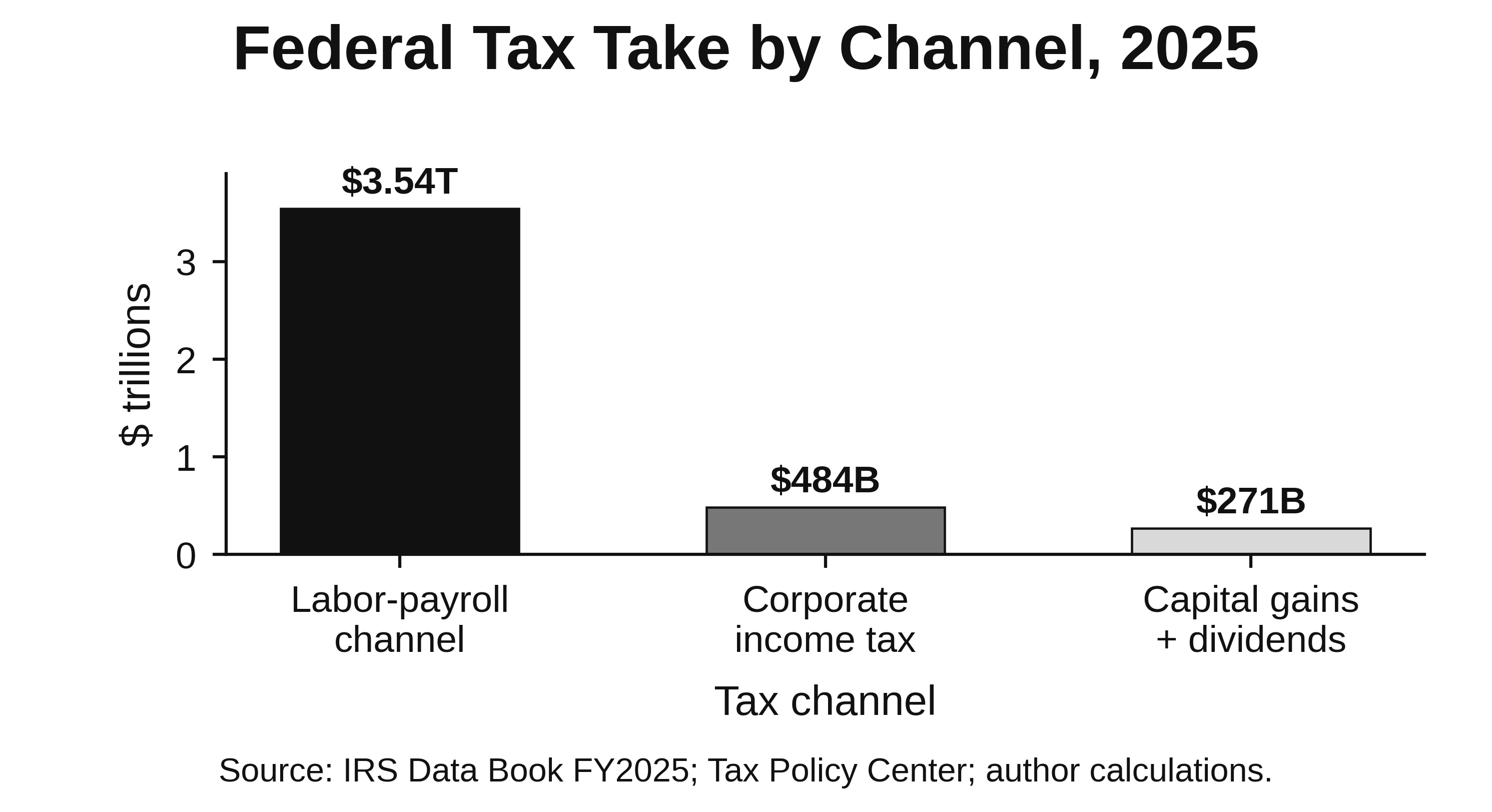
That means roughly $3.54 trillion was collected through the labor-payroll channel. Against a wage base of roughly $13 trillion, the effective federal tax burden on labor is near 27%. Federal corporate income-tax collections were about $484 billion, which is a fraction of what Washington collects from wages, salaries, and payroll-linked taxation.
The structure of FICA is central to the argument. In 2025, Social Security tax applied to wages up to $176,100. The employee paid 6.2%, and the employer paid another 6.2% on the same wage base. Medicare tax had no wage cap, with the employee paying 1.45% and the employer paying another 1.45% on all covered wages. For most workers below the Social Security wage base, the combined FICA burden was 15.3% of wages, split between the worker and the company. The employer-side cost alone added 7.65% to the wage bill before healthcare, training, compliance, office space, or management time entered the calculation.
The capital-gains and dividend question needs to be handled carefully. Tax Policy Center estimates that the federal government collected roughly $271 billion in individual income tax from long-term capital gains and qualified dividends combined in 2025. That number is meaningful, but it does not change the comparison because it remains far below the $3.54 trillion collected through the labor-payroll channel. Treasury’s separate 2025 estimates are also important, but they measure foregone revenue from preferential rates rather than taxes paid. Treasury estimates that preferential treatment for qualified dividends reduced federal revenue by about $40 billion in 2025, while preferential treatment for capital gains reduced revenue by about $119 billion. These numbers reinforce the point that capital income receives more favorable treatment, but they should not be treated as equivalent to corporate income-tax receipts.
Capital-gains taxes should not be included in the main comparison because they are not directly linked to annual corporate profits. They are taxes on realized asset appreciation, shaped by market prices, holding periods, and investor timing decisions. Qualified dividends are closer to the profit stream, but even there the tax is paid by shareholders rather than companies and depends on payout policy and investor ownership structure. This is not a perfect comparison, and it is open to debate, but I think the cleanest comparison is between the labor-payroll channel and federal corporate income-tax receipts. The former is automatic and tied to employment. The latter is direct taxation of corporate profit, which is the income stream AI is likely to expand.
That comparison still understates the distortion because it treats the issue only as a revenue problem. The more important point is the incentive embedded in the tax code itself. A company that hires a person pays wages, benefits, employer payroll taxes, unemployment insurance, workers’ compensation, compliance costs, and administrative overhead. A company that deploys AI pays a vendor, buys software, rents compute, or builds internal systems. The task may be economically similar, especially as AI improves, but the tax treatment is not. Human cognition arrives with payroll taxation attached, while artificial cognition does not trigger FICA at the point of deployment.
Assume a company has a role that costs $100,000 in wages. Before healthcare, training, office space, management time, and compliance, the employer owes another $7,650 in payroll taxes. The employee also has $7,650 withheld, reducing take-home pay and funding Social Security and Medicare. Now assume the same company can buy an AI system for $100,000 that performs enough of the role to make the human position unnecessary. The company pays the invoice and avoids the employer-side payroll tax attached to the worker. The government may collect tax somewhere else in the chain, but the payroll tax connected to that job has disappeared.
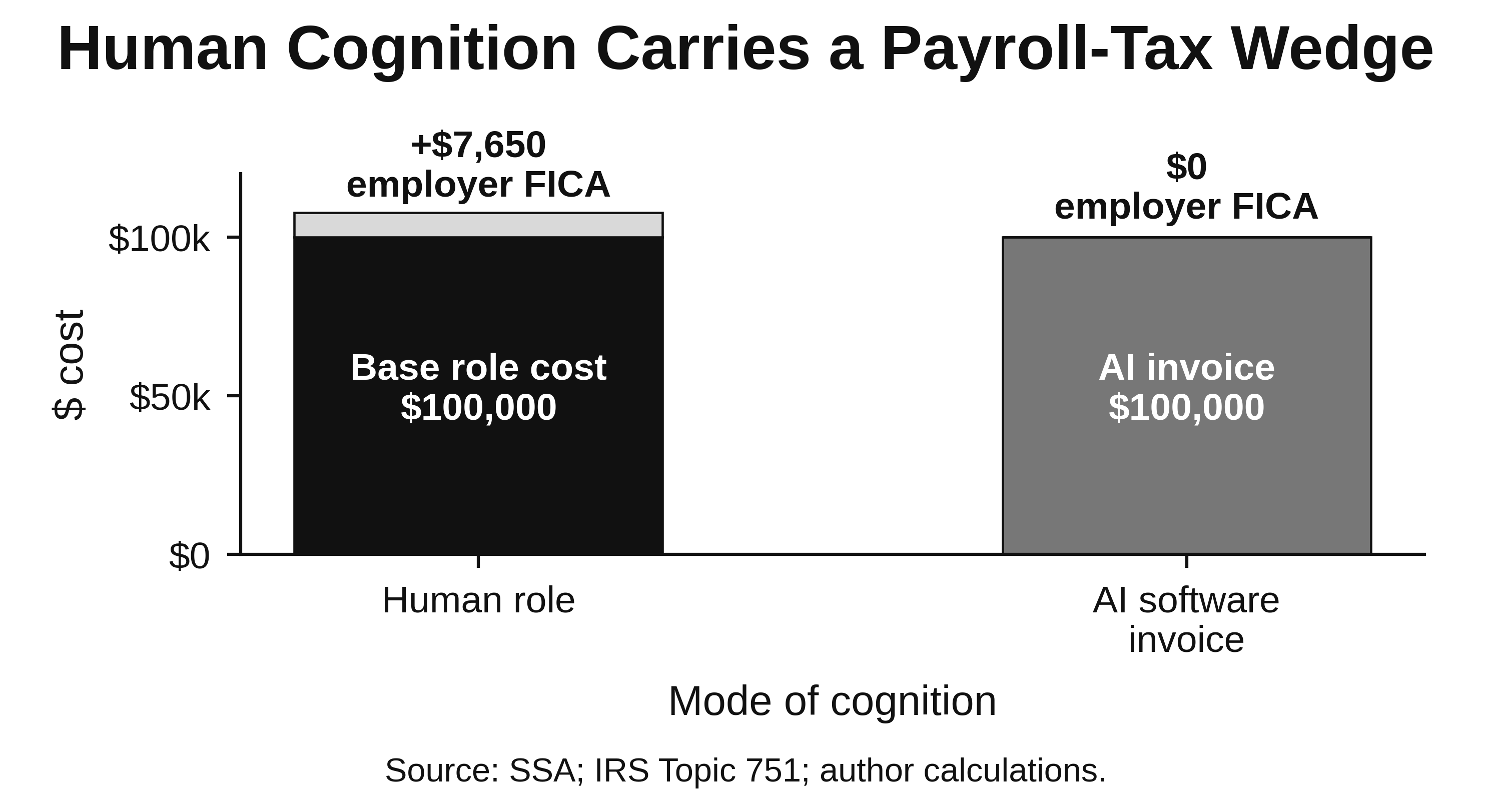
And that is before any allowance for the assumed cost savings of AI versus the current cost of labor.
That is not a neutral tax system. It is a tax system that penalizes human employment and leaves the software substitute outside the payroll-tax base. Companies already have operational reasons to adopt AI: speed, consistency, scalability, and lower marginal cost. The tax code adds another reason by making people more expensive than software before any productivity comparison is made. This does not mean every job is at immediate risk, and it does not mean artificial cognition is equivalent to human cognition today. It means that as AI improves, the tax code will increasingly tilt substitution decisions against workers.
The unfairness sits beneath the productivity story. A human worker competing with artificial cognition is not competing only on ability, output, reliability, or cost. The worker is competing against a tax system that attaches a funding obligation to employment but not to software. If two inputs can perform the same task, and one carries payroll taxation while the other does not, the playing field is not level. The tax code is not passively observing the transition from labor to capital. It is helping finance the transition by making labor the more heavily taxed input.
The defenders of the current system will argue that AI is not tax-free. They are right, but that does not solve the problem. The software vendor may pay corporate income tax, its employees may pay payroll taxes, its shareholders may eventually pay taxes on dividends or realized capital gains, and the data center may pay property or electricity-related taxes. None of that changes the decision facing the company replacing a person with software. At the point of substitution, the hiring firm removes a worker from payroll and removes the FICA burden attached to that role. The tax base does not vanish entirely, but it moves into channels that are less automatic, less labor-linked, and usually more favorable to capital.
This distinction is essential because fiscal policy is still built around the paycheck. W-2 income is visible, recurring, and collected every two weeks before the worker ever sees the money. Capital income is mobile, easier to defer, and more exposed to legal structuring. Payroll taxes fund Social Security and the hospital insurance portion of Medicare, which means the system depends on employment remaining central to the economy. AI challenges that foundation directly. If output rises while payroll employment grows slowly, the government can have GDP growth, profit growth, and weakening social-insurance revenue at the same time.
That is the fiscal trap AI creates. The economy can look healthy in aggregate while the tax base deteriorates underneath it. GDP can rise, margins can expand, and equity markets can grind higher, even as the government’s most reliable revenue channel grows more slowly. This is not the pattern of a conventional recession, where tax receipts fall temporarily and recover when employment returns. AI displacement is different because the task may not return when demand recovers. If software performs the role faster, cheaper, and with no payroll-tax obligation, the old job becomes a cost structure that management has little reason to rebuild.
The result is a feedback loop that policymakers are not prepared to confront. Companies adopt AI to improve productivity and protect margins. The adoption reduces labor intensity and weakens payroll-linked revenue. The same substitution increases profits, but the tax code captures those profits less efficiently than wages. Deficits widen, not because the economy is weak, but because the income mix has changed. Washington then faces rising transfer pressure from displaced workers while the most reliable tax channel becomes less able to fund the promises already made.
This is why the Federal Reserve is almost irrelevant to the problem. Rate cuts can support asset prices, ease financial conditions, and prevent liquidity stress from becoming systemic. They cannot make a company rehire a worker whose function has been absorbed into software. They cannot rebuild the payroll-tax base if output is increasingly generated by capital rather than labor. The Fed was designed to manage cyclical weakness in a labor-driven economy. It has no instrument designed to correct a tax code that makes human work more expensive than artificial cognition.
The policy answer should begin with neutrality between human and artificial cognition. If the tax code wants to fund Social Security, Medicare, and the federal state through the productive economy, it cannot place most of the burden on employment while exempting the software that replaces employment from payroll taxation. That does not require a cartoonish robot tax, and it does not require punishing every company that adopts AI. It requires admitting that payroll taxation was designed for a world where labor was the main productive input. Once capital and software perform a larger share of the work, the tax base has to follow the work.
The cleanest reform is to reduce the tax penalty on labor while increasing the burden on capital-linked income. Ordinary income, qualified dividends, and corporate profits cannot be treated as separate worlds when AI is shifting income from workers to owners. Capital gains belong in a different category for the purpose of this calculation because realization is discretionary and not directly tied to current-year profits. That does not mean capital gains should escape reform, and it certainly does not mean the preferential treatment of realized gains is defensible in a capital-heavy economy. It means the central comparison in this report should remain focused on the automatic taxation of labor versus the direct taxation of corporate profits. That is where the employment incentive is most visible.
Personal income-tax rates could come down if the effective tax rate on corporate profits and distributed capital income rose meaningfully. Corporate taxation should be judged by what companies actually pay, not by headline statutory rates that bear little resemblance to the final transfer to the state. Dividend taxation should be part of the broader debate because distributed profits are one of the ways corporate earnings reach owners. Payroll taxation should be redesigned so the burden of funding social insurance does not fall overwhelmingly on human work. The objective is not anti-business. The objective is to stop taxing the input being displaced while under-taxing the input doing the displacement.
Corporate America will resist this because the current system works beautifully for capital. Companies get the productivity upside from AI, shareholders receive the margin benefit, and the government absorbs the revenue loss from a weaker payroll base. That bargain cannot survive indefinitely. A country can tolerate high profits, rising asset values, and aggressive automation if the gains are broadly taxed and politically recycled. It cannot tolerate a system where companies are rewarded for replacing workers, workers fund the state until they are displaced, and the software substitute carries none of the same social obligations. The current tax code may have been defensible in a labor economy, but it becomes indefensible in an AI economy.
The political consequences will not arrive as a clean policy debate. They will arrive as anger, populism, resentment, and hostility toward the firms that benefit most from automation. Investors should not dismiss that risk as moralizing from people who do not understand productivity. Capital’s current dominance depends on a stable society, a functioning state, and a tax system viewed as legitimate enough to survive democratic pressure. If AI allows companies to produce more with fewer people while the fiscal burden remains on labor, the legitimacy of the system will weaken. The danger is not that capitalism becomes too profitable, but that it becomes too visibly detached from the workers and taxpayers expected to support it.
For decades, I believed America’s fiscal problem was manageable because the country’s growth engine was stronger than Washington’s dysfunction. I still believe in the strength of U.S. corporate America, and I remain convinced that AI will reinforce many of America’s economic advantages. What has changed is my view of the tax base beneath that advantage. A labor-based tax system cannot fund a capital-heavy economy, and it certainly cannot survive if the tax code rewards the replacement of taxable workers with untaxed software. The United States does not need to stop AI adoption, which would be impossible and economically self-defeating. It needs to stop pretending that taxing human cognition while exempting artificial cognition is a neutral way to fund the state.